

September 3, 2026 – Contractors, ready-mix producers, and concrete equipment buyers are giving more attention to cement silo level monitoring as plant teams look for steadier material flow, fewer delivery interruptions, cleaner transfer points, and clearer batch data. The discussion is not only about choosing a larger silo. It is about understanding how storage, high-level indication, screw conveyor feeding, dust collection, pressure relief, and control room visibility work together during daily production.
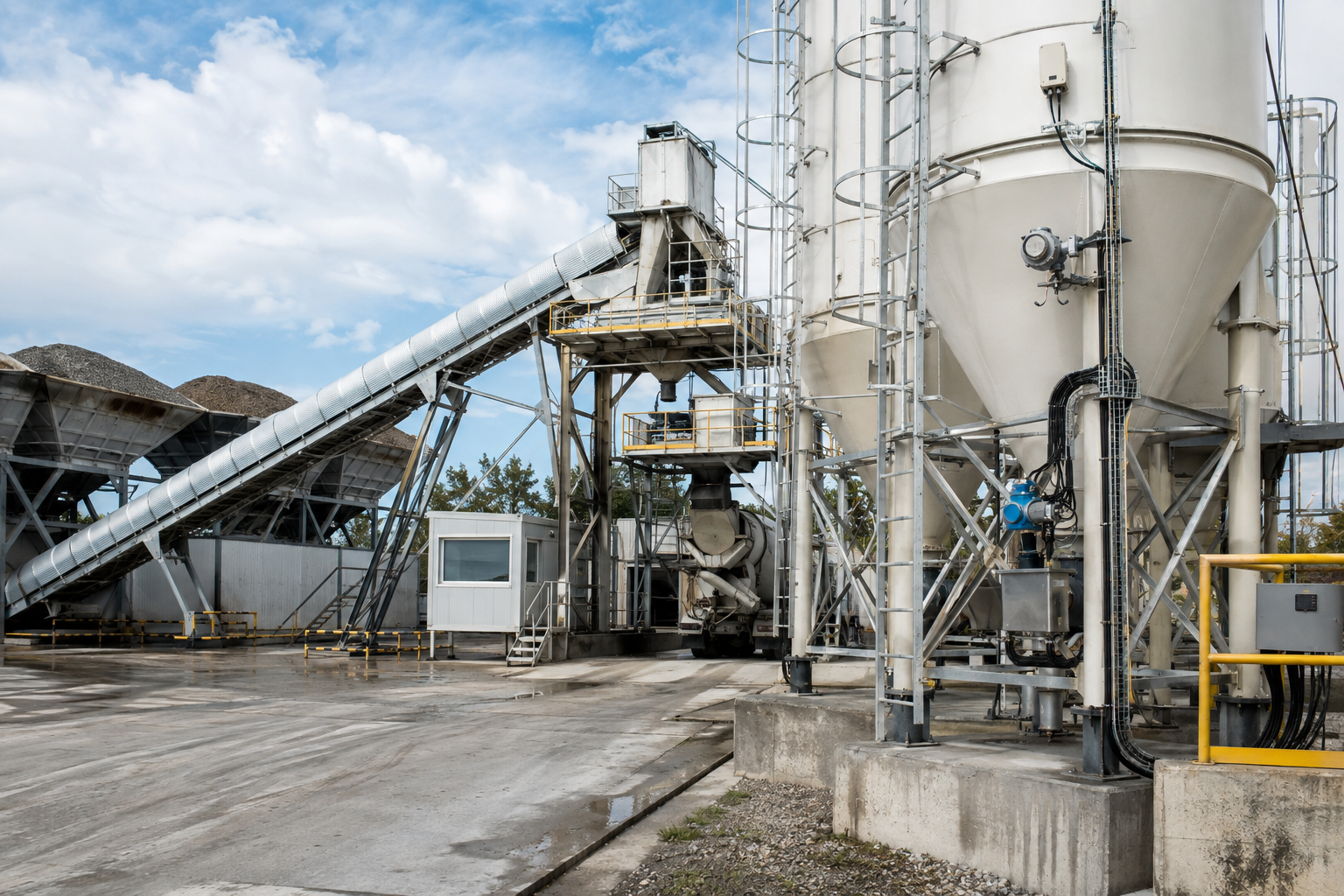
This article is an original industry analysis for construction contractors, ready-mix producers, plant managers, and concrete equipment buyers. It does not rely on specific third-party company announcements, customer cases, price data, or project claims. The focus is practical planning for cement storage, silo level sensing, overfill prevention, material transfer checks, batching plant automation, and maintenance access.
Why silo monitoring is becoming part of plant selection
A stationary concrete batching plant or mobile system is often selected by rated output, aggregate bin layout, mixer model, cement silo capacity, weighing accuracy, and automation level. Those specifications still matter, but they do not fully describe how cement is received, stored, monitored, and transferred into the batching process. A plant can have adequate mixer capacity and still lose time if silo filling, sensor checks, dust collector maintenance, or screw conveyor feeding are poorly coordinated.
Early review does not mean every plant needs the same sensor package or silo arrangement. It means the material storage system should be reviewed with the same care as aggregate bins, conveyor angle, mixer discharge height, truck loading access, electrical routing, and control room layout. A compact project plant, a mobile concrete batching plant, and a permanent ready-mix yard may all need different storage strategies, but each needs reliable indication of how much cement is available and how the silo is behaving during filling and discharge.
Level data should support the production workflow
Cement silo level monitoring is most useful when it supports the way the plant actually works. Plant teams can review cement delivery, high-level indication, silo venting, filter cleaning, screw conveyor operation, cement weighing, mixer charging, batch records, and dispatch timing as one operating sequence. This helps managers understand whether interruptions are tied to material shortage, slow transfer, operator visibility, sensor maintenance, or delivery scheduling.
The control room may show batch count, recipe selection, aggregate weights, cement dosage, water correction, admixture dosing, and mixer timing. Silo data adds another operating layer. If the plant frequently pauses near the end of a delivery cycle, if cement transfer speed changes unexpectedly, or if operators rely only on manual checks, the team can review storage visibility before assuming that a larger equipment change is required.
The silo area needs clear inspection access
The silo area is one of the most important maintenance zones in a concrete batching plant. Level sensors, high-level alarms, pressure relief valves, dust collector elements, fill pipes, aeration lines, discharge gates, and screw conveyor drives should remain reachable for inspection. Access platforms, ladders, handrails, electrical cabinets, and cable routes should be planned before the plant is installed, especially where several silos sit close together.
Inspection access should not be treated as a late detail. A sensor that is difficult to reach may be checked less often, and a filter or pressure relief device that is hard to inspect can become a routine service problem. For temporary plants, the review may focus on quick installation and relocation. For permanent ready-mix yards, it may include multiple silos, separate fill connections, walkways, and enough clearance for regular maintenance.
Material transfer checks can reduce avoidable stoppages
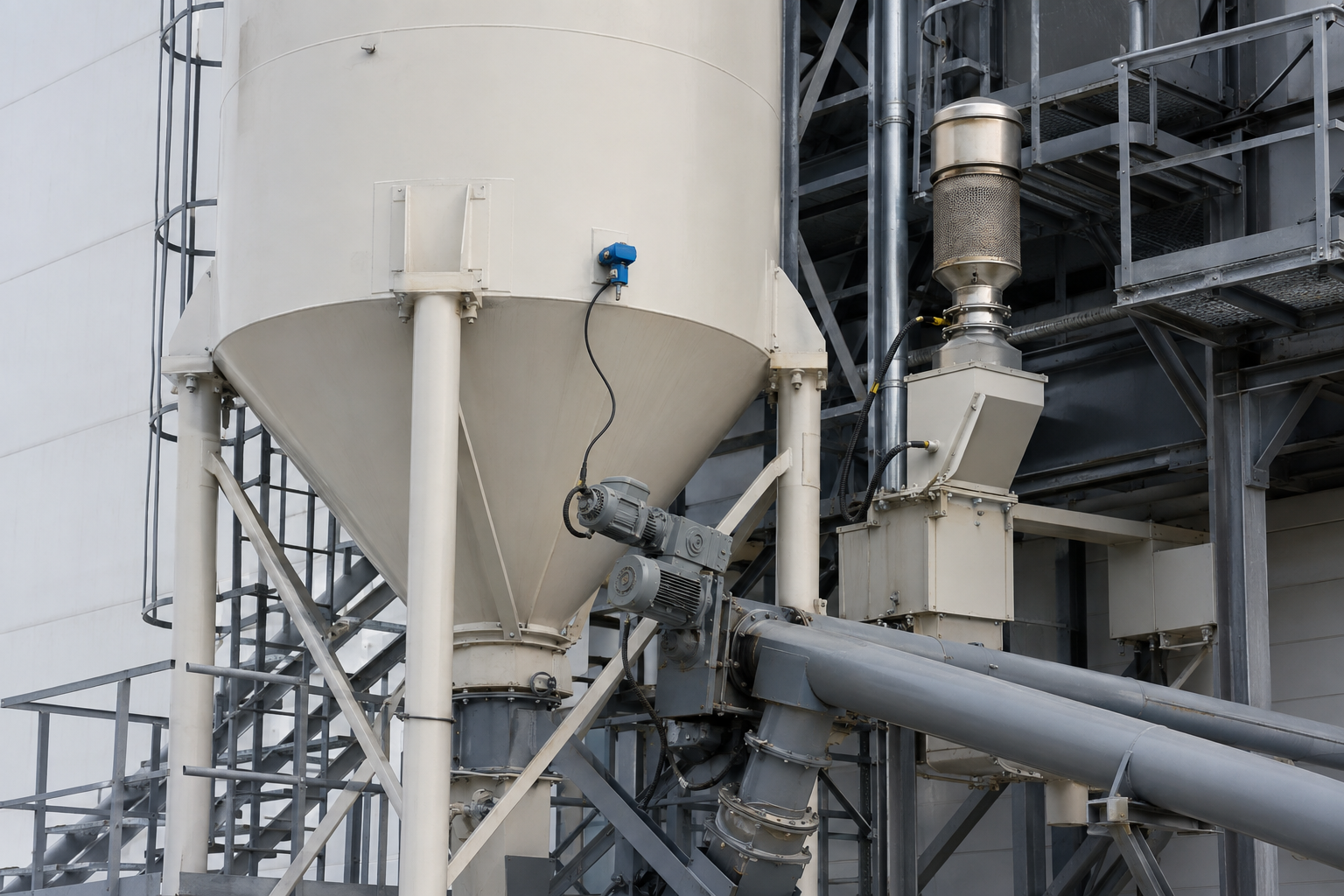
Cement storage is only one part of the material flow. The silo cone, butterfly valve, screw conveyor, reducer, motor, inlet connection, outlet chute, flexible joint, weighing hopper, and mixer charging point should be reviewed together. If cement transfer slows, the cause may be mechanical wear, poor aeration, material bridging, blocked filters, sensor problems, or control settings. A practical inspection routine helps operators separate normal variation from a developing fault.
The concrete mixer should be reviewed with the cement weighing system and transfer route. Mixer charging behavior, cement dosage, water correction, aggregate moisture adjustment, and batch timing all influence consistency. A plant that can see material availability and transfer performance more clearly is better positioned to keep the mixer working at a stable rhythm.
Dust control and overfill prevention should be reviewed together
Silo filling creates several related planning questions. The plant needs a clear fill connection, a working dust collection path, appropriate venting, high-level indication, and operator communication during delivery. Overfill prevention is not only a sensor issue. It also depends on delivery practice, alarm visibility, filter condition, pressure relief inspection, and whether operators have enough information before material is blown into the silo.
Dust control should remain visible in the same review. Dust collector elements, vent lines, gaskets, level probes, pressure relief equipment, and silo top access should be included in the service plan. A storage system that works during commissioning but is difficult to maintain can create avoidable downtime later.
Batch data should connect storage and production decisions
Batching plant automation can help connect storage planning with production decisions. Useful records may include batch count, recipe selection, cement target weight, actual cement weight, water and admixture dosing, mixer time, alarm history, and operator notes. These records are not a replacement for inspection, but they can help plant teams see whether material flow, weighing accuracy, or production rhythm is changing over time.
Storage data should also be coordinated with dispatch and jobsite supply. If concrete is supplied to a concrete pump, material availability, batching time, mixer truck loading rhythm, and pump receiving access all influence delivery reliability. A smooth silo and batching workflow cannot solve every jobsite delay, but it can reduce avoidable production-side uncertainty.
Practical checklist for plant teams
- Review cement silo capacity, fill pipe access, high-level alarm position, and sensor visibility before finalizing the plant layout.
- Keep level sensors, dust collectors, pressure relief valves, aeration lines, discharge gates, and screw conveyor drives reachable for inspection.
- Check whether silo filling communication, alarm response, filter cleaning, and delivery scheduling are clearly assigned.
- Compare cement target weight, actual cement weight, batch timing, transfer speed, and alarm notes by shift.
- Review the screw conveyor route, motor access, reducer clearance, flexible joints, and weighing hopper inlet for maintenance space.
- Coordinate cement availability with aggregate feeding, water dosing, admixture dosing, mixer timing, truck loading, and dispatch plans.
- Train operators to treat abnormal level readings, slow transfer, repeated alarms, and visible dust as inspection triggers.
FAQ
What does cement silo level monitoring include?
It can include high-level alarms, continuous or point level indication, control room display, delivery communication, inspection access, sensor maintenance, and checks around filling and discharge behavior.
Does every concrete batching plant need the same silo monitoring setup?
No. A mobile plant, compact project plant, and permanent ready-mix plant may need different silo capacity, sensor type, alarm arrangement, control display, fill connection, and service access.
Why should dust collection be reviewed with level monitoring?
Silo filling, venting, dust filtration, overfill prevention, and pressure relief are related operating checks. A level alarm is more useful when the surrounding filling and dust control equipment is also maintained.
What information should buyers prepare before discussing plant configuration?
Useful details include production capacity, plant type, cement consumption, silo number and size, cement delivery method, mixer model, automation needs, dust control expectations, screw conveyor layout, pump use, service access, and spare parts support needs.
Conclusion
Cement silo level monitoring is becoming an earlier planning topic because reliable concrete production depends on more than rated output. A useful review connects silo capacity, high-level indication, overfill prevention, dust collection, screw conveyor access, weighing accuracy, batching records, mixer timing, concrete pump coordination, and maintenance routines. Buyers can review the product center or contact hengyuan Concrete Machines with project details to discuss concrete batching plant configuration and support needs.
Our Whatsapp: +86 199 3949 4756