
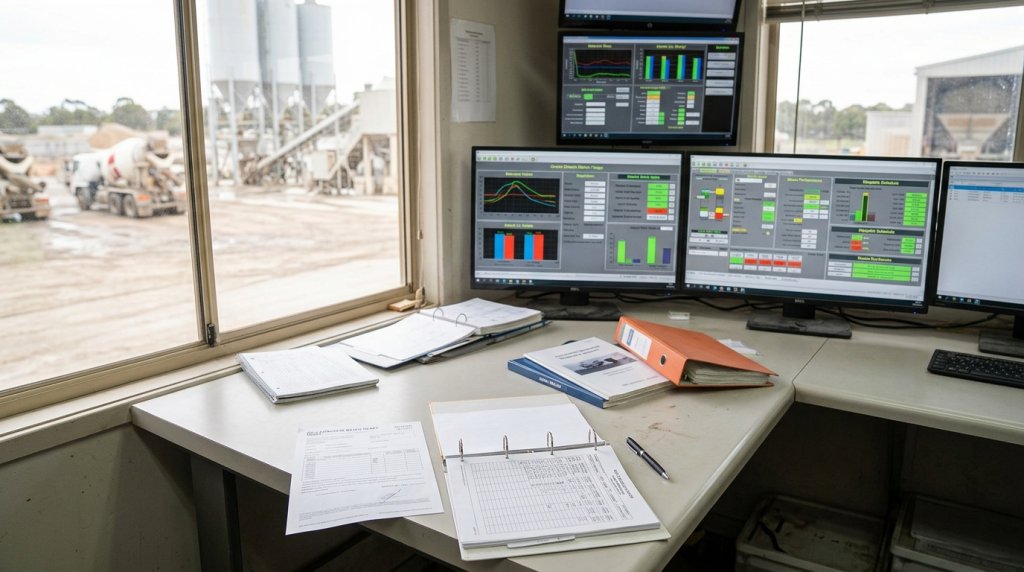
A concrete batch ticket review should connect what the plant intended to make with what was actually batched, loaded and delivered. The ticket is not a substitute for the plant’s production record, and a clean printout does not prove that every question has been resolved. This industry analysis offers six practical checks for handling exceptions without guessing at a cause or quietly rewriting the evidence.
Ticket formats and required fields vary by project and jurisdiction. The producer’s quality plan, approved mixture, customer agreement and applicable specifications determine the formal acceptance process. The checks below are a planning aid for production and quality teams, not a universal compliance checklist. They are especially useful when an operator sees an alarm, a material adjustment or a difference between the batch screen and the delivery document.
Contents
Why an Exception Review Matters
A delivery ticket travels with a load, while the batch system may retain more detail about targets, actual quantities, alarms and operator actions. When those records are considered separately, a small exception can become difficult to reconstruct later. A structured concrete batch ticket review ties the ticket number to the underlying batch and identifies who must evaluate a discrepancy before it is treated as closed.
Industry quality guidance includes delivery tickets and production records among the documents a ready-mixed concrete producer should maintain. It also treats the ticket as part of the communication between producer and jobsite. That broad principle does not tell a team which specific load to accept. Qualified personnel must apply the approved project requirements. Hengyuan’s batching plant operations guide discusses the wider control-room and handover context; this article concentrates on ticket exceptions.
Six Concrete Batch Ticket Review Checks
1. Match the ticket to the correct load and mixture
Begin with identifiers: ticket number, truck, plant, date, batch reference, destination and mixture designation. Compare them with the order and the plant’s own production record. A similar-looking mixture name is not enough if the project uses several approved versions. If an identifier is missing or inconsistent, mark the issue and contact the person designated by the quality plan rather than assuming that the printed ticket belongs to the nearest batch.
Some plants split an order across more than one batch or truck. In that case, record which production entries make up the load. The purpose of this concrete batch ticket review step is traceability, not a claim that one document format fits every producer. A reliable match prevents later reviewers from investigating the right symptom against the wrong load.
2. Compare target and actual material records
Where the system provides them, preserve target and actual values for the affected ingredients. Look for a material quantity that differs from the intended recipe, a correction that was applied, or a value the operator had to enter manually. A difference is a question for the plant’s quality process; it is not automatically a rejected load or proof of equipment failure. The review should identify the material, the batch and the recorded difference before anyone proposes an explanation.
Aggregate moisture corrections, water additions and admixture dosing can affect how a record is interpreted. Use the definitions and limits in the approved mix and quality plan. Do not copy a tolerance from another project or replace an original reading with an estimated value. If the ticket summarizes several batch-system entries, keep the detailed report available so that the summary can be traced back to its source.
3. Preserve alarms, overrides and operator notes
A ticket may not show every alert that appeared during batching. Link the relevant alarm log or operator note to the load, including the time and the action taken. Distinguish an alarm that was acknowledged from a condition that was investigated and resolved. The same distinction applies to a manual override: recording that it happened is not the same as confirming why it was appropriate.
A practical concrete batch ticket review asks whether the exception could affect material quantities, mixing, delivery timing or the ability to trace the load. The authorized reviewer decides what evidence is sufficient. If the control system cannot export a complete event history, document that limitation rather than presenting an incomplete printout as a full record. The aim is an honest audit trail, not a perfect-looking page.
4. Reconcile batch, loading and dispatch times
Check the sequence of batch start, loading, truck departure and arrival information where those timestamps are available. A gap may reflect waiting, a planned hold or a data-entry problem. Do not infer the cause from the clock alone. Ask the dispatcher and operator to identify what actually happened, then preserve the original time fields and any explanation beside them. If a timestamp was corrected, the record should show who made the correction and why.
Timing matters because the ticket may be used by both the plant and site team to understand the load’s history. The producer’s specifications and procedures govern decisions about elapsed time and mixing. A concrete batch ticket review should therefore join dispatch information to production data without inventing a universal time limit or treating an unexplained delay as harmless.
5. Record site-side changes separately
Some loads receive an authorized water or admixture adjustment after leaving the plant. Such an action should be documented under the applicable project and producer procedure, with the responsible people and the resulting record clearly identified. Do not merge a site-side change into the plant’s original batch quantities. Keeping the two stages separate helps a reviewer understand what the plant supplied and what changed later.
Industry guidance discusses documenting site-side additions on the delivery ticket and retaining a record of the adjustment. It does not authorize an unreviewed change for every project. The concrete batch ticket review should ask who requested an adjustment, who approved it, what quantity was recorded and whether the required subsequent process was followed. If the answer is unknown, label it unknown and refer the matter to the designated quality contact.
6. Assign a disposition and close the loop
An exception record needs an owner and a decision. The decision might be to request missing evidence, have quality staff assess the load, correct a clerical field with an audit trail, or investigate equipment before later production. The article does not prescribe which disposition is right. It asks the team to record the person responsible, the evidence reviewed, the decision date and any follow-up that remains open.
Closing the loop also means telling the next shift and the appropriate site contact what they need to know. A corrected ticket should not erase the original or hide an operational event. If the same exception recurs, link the cases so that maintenance and quality staff can see a pattern. A concrete batch ticket review is useful only when its conclusion can be understood and verified by someone who was not present at the plant.
A Useful Review Record
A short exception form can capture the six checks without becoming another unmanageable report. Include the ticket and batch identifiers, the mixture designation, the field or event in question, the related source record, the operator’s factual note, the reviewer, the decision and the closeout reference. Keep attachments such as alarm exports and revised ticket copies together with the original. Make the path to the evidence clear to production, quality and dispatch personnel.
Review several exceptions periodically. Repeated mismatches in the same field may point to a data-mapping or training issue; repeated material deviations may require a different investigation. Neither pattern alone proves a cause. The value of the record is that it directs attention to a defined question and preserves the information needed to answer it. A good process avoids both extremes: dismissing every discrepancy as paperwork and stopping every load without a proportionate review.
Hypothetical Ticket Example
Imagine a hypothetical plant where a delivery ticket shows the right mixture designation and truck, but its departure time differs from the dispatch log. This is not a Hengyuan customer case or a real project event. The operator keeps both original records, notes the batch and ticket numbers, and asks the dispatcher to explain the sequence. Quality staff then decide whether the discrepancy is clerical or whether it changes the load’s review under the project’s requirements.
The example does not establish that the concrete was delayed or that a system failed. A copied timestamp, a queue at the loading point or an incomplete log could each need checking. Separating the observed mismatch from an assumed cause protects the evidence and keeps the decision with the authorized team.
Closing Review
A concrete batch ticket review should make an exception easier to explain, not merely make a document look tidy. Match the load and mixture, compare material records, preserve alarms and overrides, reconcile times, document site-side changes separately and assign a clear disposition. Hengyuan recommends adapting these six checks to each plant’s quality plan and project requirements while keeping the original production evidence intact.
Contact Us: +86 199 3949 4756