
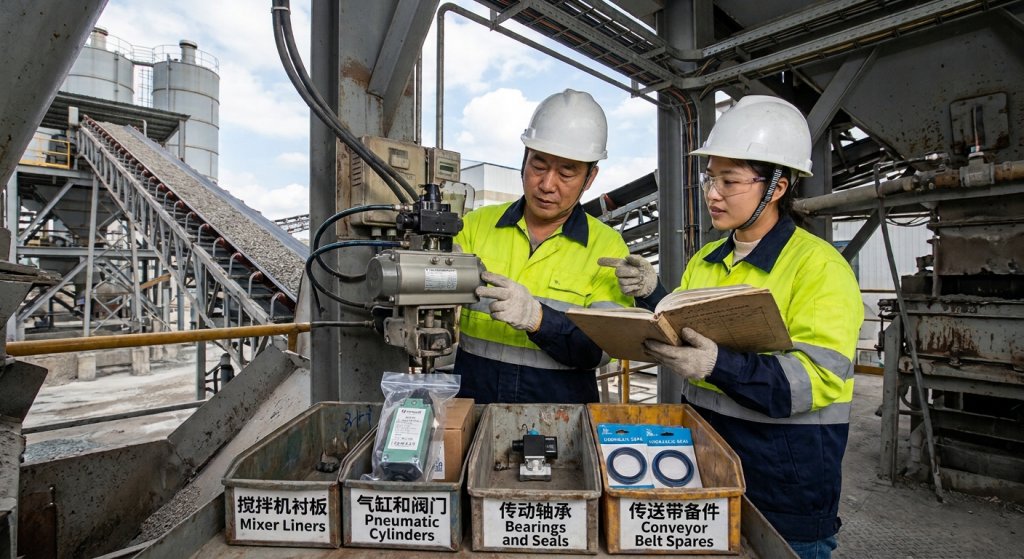
Concrete batching plant spare parts are easiest to plan before a conveyor stops or a valve starts leaking. An emergency order can leave an otherwise healthy plant idle while the crew waits for one small component. A practical spare parts plan starts with the equipment that would interrupt batching, then connects each item to a clear inspection and replenishment rule.
This industry analysis is a planning guide for plant managers and maintenance teams. It describes seven decisions that make a concrete batching plant spare parts list useful in daily operations. The exact stock and service intervals should always follow the equipment manuals, actual operating conditions and the site’s own maintenance records.
Contents
Start With the Failure Path
A catalogue shows what a plant contains. A concrete batching plant spare parts list must answer a different question: what can fail, how quickly can it be diagnosed, and what happens to production while the replacement is obtained? A low-cost sensor can stop batching if the controls cannot confirm a gate position. A large structure may be expensive but unlikely to need an immediate stocked replacement.
Map the route a batch takes through aggregate feeding, weighing, cement and water dosing, mixing, and discharge. At each step, identify the components that can halt the route and those that merely reduce throughput. Ask the operator and the maintenance technician separately; each will notice a different kind of delay. Record the answer in plain language so a new shift can use it.
7 Concrete Batching Plant Spare Parts Decisions
1. Separate production-stopping items from planned wear
Group parts by the consequence of failure. A failed discharge gate actuator may stop a batch from leaving the mixer. A mixer liner can usually be measured and replaced during a planned shutdown. Both matter, but they need different reorder rules.
For each item, record the affected process, the likely symptom, and whether safe production can continue. Avoid vague labels such as “critical.” A description like “aggregate gate will not confirm closed; batching cannot start” gives the crew a useful reason to stock the component.
2. Match every part to the installed machine
Plants are often modified over time. A motor, cylinder or sensor that was correct at commissioning may have been replaced with a different specification. Build the list from the installed nameplate and the latest drawing, then verify physical dimensions and connection details where they matter.
Capture the manufacturer’s part number, the plant location, the compatible model and any approved substitute. If a replacement requires a different mounting bracket or connector, stock the complete kit or explain the extra work in the record. A technically similar part is not always a fit for the shift that needs it.
3. Use lead time and operating exposure together
Long supplier lead time alone does not justify a large inventory. A rarely used component may be shared between plants or ordered for a scheduled overhaul. Equally, a fast-moving consumable with a short lead time can still cause a stop if the plant uses the last unit without placing a new order.
Estimate consumption from maintenance history, then compare it with delivery time and the plant’s production schedule. Concrete batching plant spare parts that are used often need a replenishment trigger as well as a minimum quantity. When history is thin, start with a modest minimum and review it after several service cycles. Write down the assumption so the next review can change it based on evidence.
4. Protect parts during storage
Concrete batching plant spare parts are only useful if they still work when removed from the shelf. Keep electrical components dry and in their original protective packaging. Store seals and flexible hoses away from heat, direct sunlight and oils that can damage them. Protect machined surfaces and keep heavy parts on stable shelves with a safe handling route.
Mark each bin with the equipment location and part number. If two valves look alike but have different actuation or pressure ratings, separate them clearly. Periodically inspect packaging and dates, especially for components with manufacturer-defined shelf-life limits.
5. Make replacement work safe and repeatable
A stocked part does not make an intervention safe. Before a replacement, the crew needs to identify electrical, pneumatic, hydraulic and mechanical energy, isolate it, and verify the isolation under the site’s procedure. This is especially important around mixers, conveyors and compressed-air actuators, where stored energy or an unexpected restart can cause injury.
Keep the installation instructions, tools, lifting method and test procedure with the spare parts record. Use the applicable safety rules for the plant’s location and have a competent person verify the site procedure before work begins.
6. Connect withdrawal to replenishment
The most common inventory failure is a part used during an urgent repair and never replaced. Give every withdrawal of concrete batching plant spare parts a simple record: date, equipment, fault, part number, quantity, and who took it. The same record should create a reorder action when stock reaches its minimum.
It helps to keep one physical location for each part and count it on a regular cycle. A spreadsheet is sufficient if it stays current; a sophisticated system with old quantities is less useful. Review the last few emergency purchases at each monthly maintenance meeting and decide whether they belong on the stocked list.
7. Review the list when the plant changes
New equipment, a different cement delivery method, an altered batch schedule or a supplier change can make yesterday’s list obsolete. Update the inventory when a machine is replaced, when a substitute part is approved, and after a failure reveals a missing item.
During the review, remove obsolete part numbers from the active list only after confirming what they fit and whether any matching equipment remains. Keep the history for traceability. A short version-controlled record prevents a future technician from ordering the old item by mistake.
Turn the List Into a Working Routine
Begin with one production path rather than trying to inventory the entire site in a day. Walk from aggregate loading to truck discharge with the operator and maintenance lead. Photograph nameplates for internal reference, but verify the part number from the manual before ordering. Record an owner for each action and a date to confirm the list.
For each candidate item, fill five fields: location, failure effect, exact specification, minimum quantity, and reorder lead time. Add a sixth field for the safe replacement procedure when a part can be changed during an operational shift. The result is a short list that can actually be checked during a stock count.
The NRMCA pre-construction checklists show the value of agreeing on equipment, responsibilities and communication before work begins. The same planning habit helps a plant team decide who checks stock, who approves substitutions and who confirms a repaired machine is ready to return to service.
A Hypothetical Example
Consider a hypothetical two-mixer plant whose aggregate gate position switch fails twice within a maintenance cycle. The operator reports delayed batches, while the technician finds that the stores list carries a switch for a previous actuator model. The team verifies the installed specification, keeps one compatible switch on the shelf, updates the wiring reference and adds the switch to the weekly inspection route.
The example is a planning scenario, not a Hengyuan customer case or a reported failure rate. Its lesson is the link between an observed fault, an exact replacement and a replenishment rule. Without all three, a spare parts cabinet may still fail the plant when it is needed.
Final Check
A useful concrete batching plant spare parts plan is a living maintenance tool. It names the failure, identifies the installed part, protects the stock, and tells the next shift how to replace and reorder it. Start with the components that interrupt the production path, test the list against real maintenance events, and revise it whenever the plant configuration changes.
For equipment layout and support context, see the Hengyuan company profile. A well-maintained concrete batching plant spare parts record makes the handover between operators, technicians and purchasing clearer long before the next unplanned stop.
Contact Us: +86 199 3949 4756