
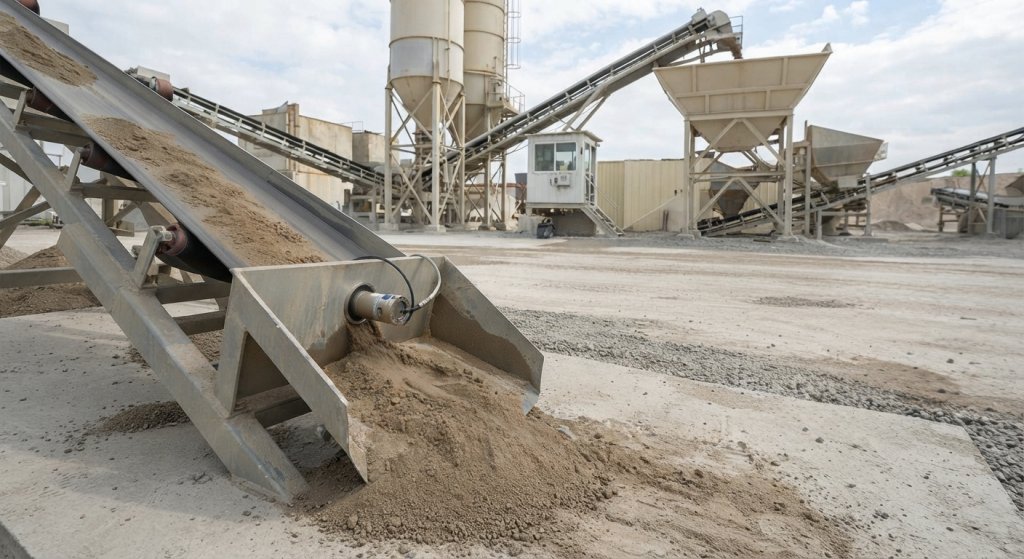
Industry analysis: A concrete plant moisture probe can make aggregate-water adjustment faster, but its reading is only useful when the plant understands what material it represents. Sand moisture may change after rain, stockpile movement or a new delivery. If a sensor value is treated as a permanent fact rather than a measurement to verify, the batching system can make a consistent correction to the wrong input. This seven-check guide focuses on probe verification and the handoff to batch-water decisions. It is not a claim about a specific Hengyuan installation or a substitute for the probe manufacturer’s instructions.
1. Identify what the probe actually measures
Start with a simple plant map: which bin, belt or weigh hopper contains the sensor, and which aggregate stream passes it? A probe that reads fine aggregate cannot automatically represent another sand source or a coarse aggregate stream. If a plant has multiple stockpiles feeding one bin, the material at the measurement point may change even when the bin name does not. The operator should be able to name the material, the sensing point and the batch recipe input affected by that reading.
The American Concrete Institute distinguishes free surface water from water absorbed inside aggregate particles. The two are not interchangeable in mixture-water calculations. A concrete plant moisture probe should therefore be interpreted in the context of the aggregate and the control system’s moisture convention, rather than as a stand-alone percentage on a screen. Confirm with the supplier whether the display represents total moisture, free moisture or a value converted by the plant software.
2. Inspect the sensing location
Before comparing numbers, look at the physical measurement point under the site’s safe access procedures. Material should pass the sensor in the way the manufacturer expects. Buildup, an exposed sensing face, damaged cable protection or a gap in the material stream may change what the probe sees. An intermittent reading during a nearly empty bin can be a material-flow problem, not necessarily an electronics problem.
Note any recent change to bin gates, conveyors, liners or the probe mounting. A maintenance job that shifts the sensing face may affect the measurement even if the display still appears normal. The right inspection and cleaning method depends on the device; do not scrape or wash a sensor merely because another plant uses that routine. A concrete plant moisture probe needs a stable mechanical relationship with the aggregate stream before its calibration can be judged.
3. Take a representative comparison sample
A sensor check needs a sample that corresponds to the material being measured. The National Ready Mixed Concrete Association’s plant-certification guidance says the aggregate sample used for moisture-probe verification should be taken as close as possible to the probe’s measuring location. That matters because a sample from the top of a stockpile may not represent the material flowing past a sensor several handling steps later. Record the source, time and plant condition so a later reviewer can understand the comparison.
If material flow varies, decide with the quality team whether one grab sample is enough or whether several samples are needed to describe the stream. Do not quietly discard an inconvenient result. For a hypothetical plant switching from one sand pile to another during a busy shift, a mismatch may reflect a real change in the material rather than a faulty instrument. This is a hypothetical planning example, not a Hengyuan customer case.
4. Use the approved reference method
Follow the probe manufacturer’s verification directions and the plant’s approved aggregate-moisture test method. NRMCA describes comparing a probe with a moisture measurement obtained by drying an aggregate sample, referring to ASTM C566. ACI also describes surface-moisture methods and the distinction between absorbed and free water. The article does not prescribe a universal numeric tolerance for every probe; the method, material and control-system calculation must be understood before accepting or correcting a reading.
Document whether the reference result is total moisture or a free-moisture value derived using the aggregate’s absorption information. Compare like with like. A difference between unlike quantities is not evidence that a concrete plant moisture probe is out of calibration. If the reference equipment or sample handling is uncertain, resolve that uncertainty before changing the sensor setting. Repeatability and a clear record are more useful than a single unexplained number.
5. Check the control-system interpretation
Even an accurate sensor can support the wrong adjustment when its signal is mapped to the wrong material or recipe field. Confirm that the displayed reading reaches the intended aggregate stream in the batching software and that the software applies the plant’s approved correction logic. Review how the system handles a missing reading, an out-of-range value or a manual override. The operator should know whether a displayed number is live, averaged, held from an earlier scan or entered by hand.
The test should not end at the instrument face. ACI notes that calibrated moisture meters may continuously monitor aggregate moisture and allow automatic adjustment of added water. That capability makes the signal path important: the quality team must be able to trace the measurement through the batch calculation. A concrete plant moisture probe verification is incomplete if the team checks the sensor but cannot explain which batch-water value the system changes.
6. Decide what to do with a mismatch
Set a clear response before a discrepancy appears. The plant should identify who can pause automatic correction, request another sample, authorize a setting change and release the system back to routine use. The decision belongs with the plant’s quality process and equipment supplier, not with a generic blog threshold. If the reading changes abruptly after rain or a stockpile switch, first check the material and sample location. If the result remains inconsistent, investigate the probe, wiring, software mapping and reference test.
Keep any temporary manual adjustment visible to the next shift. A correction made to finish one delivery should not become an undocumented permanent calibration. For wider context on storage and recipe-water planning, see Hengyuan’s aggregate moisture control guide. This article addresses the narrower verification question: whether the concrete plant moisture probe and the comparison test are describing the same material in the same way.
7. Record the result and next review
A useful verification record identifies the probe, aggregate, sample point, reference method, displayed value, calculated comparison value, date, operator and any action taken. Attach the relevant batch-control setting or change reference when a correction is made. A short record helps the plant distinguish sensor drift from a change in feed material, sample technique or software configuration. It also prevents the next team from repeating the same investigation without knowing what was already checked.
Set the next review based on the manufacturer’s directions and the plant’s quality obligations. NRMCA’s certification guidance calls for documented accuracy checks of moisture probes at least every six months for participating plants, while more frequent requirements may apply in some situations. This is a description of that program, not a claim that one schedule applies to every plant worldwide. A concrete plant moisture probe should also be revisited after relevant maintenance or a material change when the plant’s procedure calls for it.
Planning takeaway
Reliable moisture data comes from a chain of evidence: the right aggregate at the sensing point, a representative nearby sample, an approved reference method and a verified path into the batch-water calculation. The seven checks make that chain visible without pretending that a probe reading alone guarantees concrete quality. Hengyuan recommends adapting the sequence to the installed equipment, the supplier’s documentation and the plant’s quality system. Treat the concrete plant moisture probe as a measurement to understand and verify, not a number to trust automatically.
Contact Us: +86 199 3949 4756