
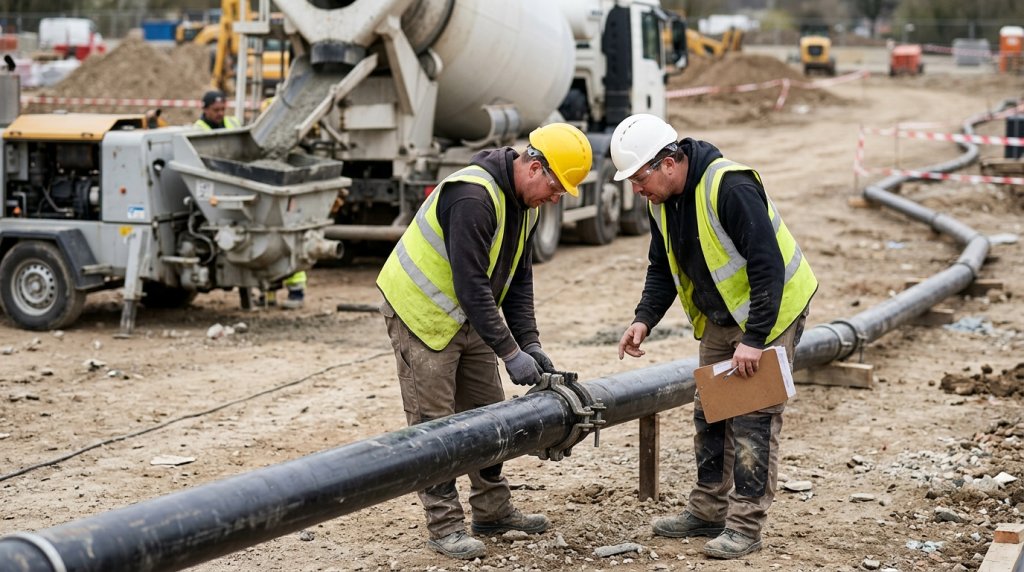
Industry analysis: Concrete pump priming is a short phase of a pour, but it depends on decisions made before the first truck arrives. The placing line, the selected primer, the discharge area and the crew’s communication all need to fit the actual pump and concrete mix. A rushed start can turn a manageable setup issue into a stoppage or a hazardous discharge. This seven-check planning guide is not a substitute for the pump manufacturer’s instructions, the operator’s training or the site’s safety plan. It does not describe a Hengyuan customer project.
1. Confirm the delivery route
Concrete pump priming begins with a line that has been planned, not merely assembled. Walk the proposed route with the pump operator and the placing crew. Identify the pump outlet, each change in direction, reductions, supported sections and the final hose position. The route determines how much line must be prepared and where a crew can safely observe the first discharge. A last-minute extension can change the start-up plan even if the pump itself has not moved.
Ask who has verified that each delivery-system component is suitable for the pump’s maximum material pressure and its intended use. The answer should come from the applicable equipment documentation and a competent person, not from the appearance of a clamp or hose. If the route changes after the briefing, pause and review the new components and discharge position before restarting. For a broader discussion of line routing and site access, see Hengyuan’s concrete pump pipeline planning guide.
2. Inspect the line and connections
A suitable route still needs sound hardware. Before concrete pump priming, have the authorized crew check the line, reducers, clamps, gaskets and end hose under the site’s inspection procedure. Missing or damaged seals, excessive wear, incompatible parts or a poorly supported change of direction are reasons to stop and resolve the issue. Do not assume that a line is ready merely because it was used on the previous shift. A new layout, a repaired section or a different pump can change the assessment.
The inspection is a coordination check, not an invitation for untrained people to dismantle a delivery system. The operator should confirm the machine is in the appropriate safe condition before anyone works on a connection. Never open a line while it is pressurized. If an issue is discovered during pumping, follow the manufacturer’s and site-specific isolation procedure; do not improvise a quick fix to protect the schedule. Record the component that was replaced or corrected so the next crew does not repeat the same uncertainty.
3. Agree on an approved priming material
Concrete pump priming prepares the internal surface of the delivery path for the first concrete. The primer choice must suit the pump, the line, the approved mix and the project requirements. Industry guidance supports priming before pumping and cautions that simply using water is not appropriate in many cases. That is a reason to plan, not a universal recipe. The correct material and quantity should be confirmed with the pump manufacturer, the concrete supplier and the project quality team before work starts.
Clarify where the priming material will come from, who approves it and how it will be identified at the site. Do not quietly change the specified concrete by adding water or another material in the hopper. Also decide where the first discharge goes. Material used for priming may not be intended for the structural placement; its handling should follow the approved project procedure. If a proprietary product is proposed, check its compatibility and use instructions rather than assuming that all products work the same way.
4. Coordinate primer and concrete supply
A start-up sequence can fail even when every individual item is available. The primer, crew, ready-mix delivery and receiving area must be ready in the right order. Confirm who will tell the driver when the pump operator is ready to receive concrete. Avoid filling the hopper early to compensate for uncertainty elsewhere. Equally, do not schedule the first truck so late that the prepared line sits idle beyond the approved procedure’s limits. The exact timing depends on the material and equipment instructions, so write down the agreed sequence rather than inventing a universal interval.
Consider a hypothetical site where the placing crew adds a short hose after the original briefing. The new hose changes the length of the delivery path and may move the discharge point near a different work area. The team should reassess the primer plan, line support and exclusion area before the operator starts. This is a planning example only, not a reported Hengyuan installation or customer result. Concrete pump priming is most predictable when the layout and delivery schedule refer to the same final configuration.
5. Keep the discharge area clear
The start of pumping can introduce or move air in the delivery system. A hose or discharge point may move unexpectedly before material flows steadily. The operator and placing crew must establish a clear area around the discharge in accordance with the equipment manual and site safety plan. Keep people away from the end hose and point of discharge during concrete pump priming and after any event that may have introduced air, such as opening or extending the line. Do not use the first visible material as proof that all air has cleared.
Agree who observes the discharge from a safe position and who gives permission to approach when flow is steady and the system is stable. The procedure should also cover where primer or rejected start-up material will be collected without placing a worker in the discharge path. If a blockage is suspected, stop and use the operator’s approved procedure. Never use compressed air as an improvised way to clear a blockage, and never open a pressurized line. These are safety boundaries, not optional productivity tips.
6. Set roles and stop signals
Concrete pump priming involves more than the person at the controls. Before starting, identify the pump operator, the person coordinating concrete trucks, the person controlling the receiving area and the designated signaler for the placing crew. Everyone should know the stop signal and how to communicate a concern immediately. A crowded site can produce conflicting instructions; a short briefing prevents two people from independently calling for concrete or moving the hose while the operator is still preparing the line.
Use the site’s approved hand signals or radios and confirm that they work along the full route. The signaler must be visible or reliably heard at the point where decisions are made. If a worker notices a leak, unusual movement or a person entering the restricted area, the response is to stop and reassess, not to wait for the next truck. The operator remains responsible for the pump and its safe operating sequence. Other team members should not take over controls or make unapproved material changes.
7. Record the start and plan a restart
A short record helps the team distinguish a planned start from an improvised one. Note the final line layout, the approved priming material, who authorized it, the discharge destination, the inspection outcome and the crew briefing. Record any deviation and the person who resolved it. These details matter if the line is later moved, extended or opened. A restart after such a change is not automatically the same as the initial start; air may have been introduced and the discharge location may be different.
Before resuming, the operator should confirm the manufacturer’s restart procedure, the line condition and the clear area with the crew. If the hopper runs low or a blockage occurs, stop and follow the applicable equipment and site instructions rather than treating the event as routine pumping. A documented handover gives the next shift a reliable starting point without pretending that one checklist can replace training. It also makes a later review more useful: the team can see whether the issue was supply timing, material selection, line configuration or communication.
Planning takeaway
Concrete pump priming is a coordinated start-up decision, not simply a material poured into a hopper. Seven practical checks cover the route, hardware condition, approved primer, delivery sequence, discharge clearance, crew signals and restart record. They help a team ask the right questions before the pour, while leaving equipment-specific decisions to the trained operator and approved documentation. Hengyuan recommends reviewing this sequence against the actual pump, concrete mix and site plan; no generic article can guarantee a safe or uninterrupted placement.
Contact Us: +86 199 3949 4756