
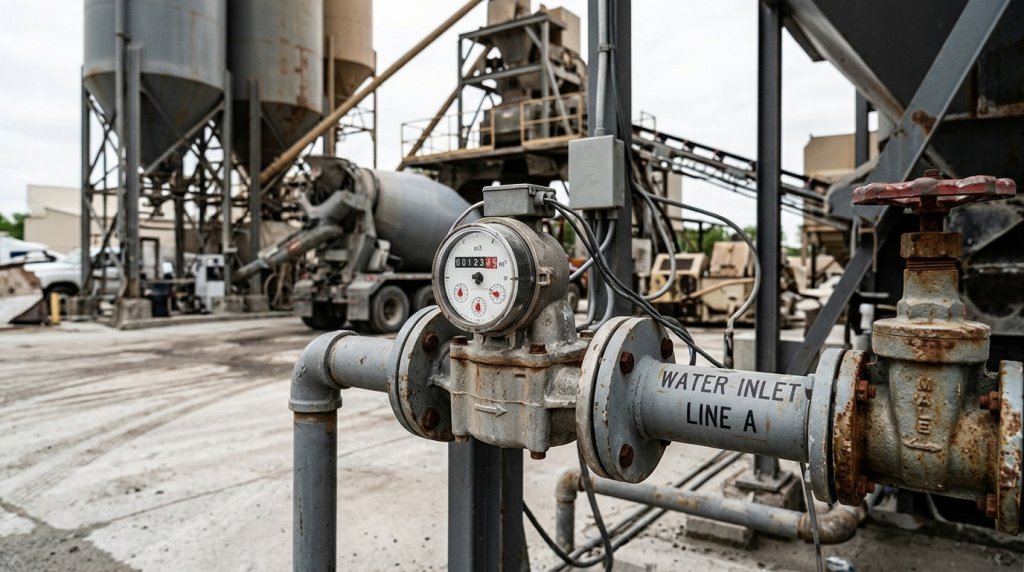
A concrete plant water meter is easy to overlook when a batching team is focused on aggregate, cement and truck dispatch. Yet water measurement belongs in the same conversation as every other ingredient measurement. A displayed number is useful only when the team understands what the meter measures, when it was checked and how an unexpected reading is handled. This industry analysis offers six practical questions for operators, supervisors and maintenance staff to discuss before relying on meter readings in routine production.
The checks are a planning framework, not a calibration procedure or a substitute for a project specification. Equipment designs, water sources and control systems vary. Qualified personnel should follow the meter manufacturer’s instructions and the plant’s approved verification process. The purpose of this guide is to make records and handoffs clearer, not to suggest that an operator should adjust a live meter to make a batch appear correct.
Contents
Why Water Measurement Deserves a Separate Review
A plant may measure water by volume or by mass, depending on its equipment and process. The reading may be shown at a local meter, in a batch controller or in a production report. Those are related views of a process, but they are not automatically interchangeable. A supervisor who sees an unusual total needs to know which device produced it and whether the displayed value represents a target, an actual addition or a cumulative counter.
Industry guidance recognizes water measurement as a matter for equipment checks and documented verification. The practical lesson is not that every plant shares one test interval or tolerance. It is that the plant should identify its applicable specification, responsible person and evidence of the last satisfactory check. For a broader look at plant planning, Hengyuan’s concrete batching plant checklist can sit alongside a dedicated water-meter record.
Six Concrete Plant Water Meter Checks
1. Identify the measurement point and the displayed value
Begin with a simple map of the water path. Which line passes through the meter? Does it cover the main water supply, a separate reclaimed-water line, a wash-water connection or only one branch of a larger system? Who reads the local display, and where does the controller obtain its value? The answer matters because a reading from one branch cannot be treated as a complete account of every water contribution to the mixer.
Record the device identifier and the units shown on the display. Note whether the figure is a batch total or an accumulating total that must be compared with an earlier reading. If the plant has several water sources, document which ones are measured separately and which are accounted for elsewhere in the approved batching method. Do not assume that a single meter captures all water entering a batch.
2. Confirm the applicable verification plan
A concrete plant water meter check needs an agreed reference, not a guess based on how long the meter has been installed. Identify the governing project requirement, plant quality plan or certification program that applies to the site. Then record who performs the verification, what method is authorized, what acceptance criteria apply and where the result is filed. The meter manual and competent technician should determine the actual test method.
This is particularly important when a plant changes controls, replaces a meter, reroutes pipework or introduces a different water source. A past verification record may not answer a new configuration question. If the applicable procedure is unclear, pause the assumption that the displayed value has been verified and ask the responsible quality or maintenance lead to resolve it.
3. Compare the reading with the batch record
Look at what the controller reports for a normal batch and what the production record retains. Are target and actual water values distinguishable? Can staff explain a manual addition or a corrected entry without erasing the original event? A clean record should allow a reviewer to trace an unusual reading to a batch, time and equipment configuration. It should not rely on someone’s memory at the end of the shift.
The comparison is a screening question, not proof of meter accuracy. A matching controller display and printed report may originate from the same signal. Independent verification is still needed under the applicable plant procedure. The operational value of the comparison is that it helps staff spot missing values, implausible jumps or undocumented changes before those observations are lost in a busy dispatch period.
4. Separate meter concerns from water-source concerns
An unexpected water total does not necessarily mean the meter has failed. A valve position, a bypass, a leak, an unrecorded manual addition or a different source path can change what reaches the mixer. Conversely, a stable displayed number does not establish that every connection is in the intended configuration. The team should note observable symptoms and let trained personnel investigate within the plant’s safety procedures.
Keep water quality and water quantity as separate questions. This article addresses how a plant plans measurement and verification; it does not determine whether a particular water source is suitable for concrete. When reclaimed or alternative water is in use, the approved mix-design and quality-control requirements must also be considered. Neither a meter reading nor a checklist replaces those decisions.
5. Define what happens when a reading is questionable
A useful procedure says who is notified, which record is preserved and who decides whether production can continue. Avoid a vague instruction to “watch the meter.” Instead, define the reporting path for a missing reading, a sudden change or a disagreement between local and controller values. The responsible person should decide whether further checks, equipment isolation or a production hold is necessary under site rules.
Operators should not bypass a sensor, alter a setting or perform an improvised calibration to clear an alarm. Those actions can obscure the original evidence and introduce new hazards. A concise handoff records the observed value, the expected context, the batch or shift, any visible source change and the person contacted. It leaves diagnosis and adjustment to qualified staff.
6. Close the loop after maintenance or replacement
When a meter, transmitter, controller input or water line is serviced, the handoff is incomplete until the plant knows what changed and how the measurement was verified afterward. Ask for the work order, device identifier, verification result and authorization to return the system to normal use. A note that says only “fixed” is difficult for the next shift to interpret.
Check that the current document is accessible where the next operator will look, not merely stored in one person’s inbox. If a controller scaling factor or display unit changed, the operating instructions and batch-record interpretation may also need review. This final check makes the concrete plant water meter part of a controlled measurement process rather than an isolated instrument.
A Useful Verification Record
A short form can make these questions repeatable without turning every shift into a technical test. Include the plant and meter identifier, measurement point, units, applicable procedure, last verification date, result, responsible reviewer and the location of supporting evidence. For an exception, add the observed symptom, time, affected batch reference if relevant, immediate notification and follow-up owner. The form should point to the qualified technician’s detailed test record rather than pretend to replace it.
Review the form when equipment configuration changes. A record built for one water line can become misleading after pipework or controls are modified. The goal is traceability: someone unfamiliar with yesterday’s shift should still understand what was measured, what was questioned and who resolved it.
Hypothetical Handoff Example
Consider a hypothetical plant whose operator notices that the controller’s actual-water field is blank for one batch while the local meter shows an increment. This is not a Hengyuan customer case or a claim about a real installation. The operator records the batch reference, time, meter identifier and both displayed observations, then alerts the designated supervisor. The supervisor follows the plant’s approved quality and safety procedures to decide what happens next. A qualified technician investigates whether the issue concerns a signal, a display, a record or the measurement itself.
The important part of the example is the separation of observation from diagnosis. The operator does not silently replace the missing value, and the team does not assume the local meter is automatically correct. The final work record states what was checked and how the accepted measurement path was restored.
Final Planning Question
A concrete plant water meter is most useful when its reading has a clear meaning, a documented verification history and an unambiguous response when something looks wrong. The six checks above give plant teams a practical discussion agenda: identify the measurement point, confirm the verification plan, compare records, distinguish source issues, define escalation and close the maintenance loop. Hengyuan recommends using that agenda alongside the plant’s own specifications, manufacturer instructions and qualified quality-control judgment.
Contact Us: +86 199 3949 4756