
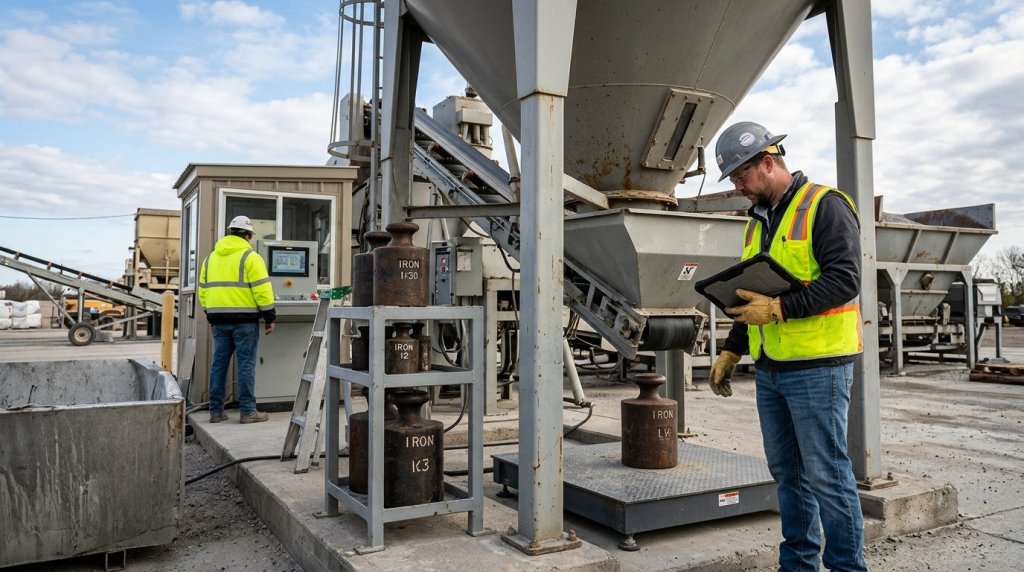
Batch plant scale verification is not a paperwork exercise to complete only when a certificate is due. It is a way to connect the quantities shown by a batching system with the quantities that the plant actually delivers to the mixer. When a reading is doubtful, the useful question is not simply whether a screen lights up. The team needs to know which device was checked, over what working range, by whom, and what happened when a result was outside the accepted limit.
This industry analysis offers six planning checks for operators, quality teams and equipment buyers. It does not replace a manufacturer’s instructions, a qualified scale technician, a project specification or a local inspection requirement. The goal is a repeatable handoff between production and maintenance, especially when a plant is moved, repaired or returned to service.
Contents
Why the Record Matters
Concrete batching depends on measured proportions. Aggregate, cementitious material, water and admixtures may be measured by different devices, and a single plant can have several scales. A check that addresses only one convenient load point cannot tell the full story about a device that normally works across a wider range. A dated pass/fail label without the applied test loads is likewise difficult to review when a discrepancy appears later.
Plant certification guidance from the National Ready Mixed Concrete Association discusses checking scales over their range of use and retaining the detailed verification data, not merely a statement that a scale passed. That principle is useful even for a plant that is not seeking that particular certification: keep enough detail for a second person to understand the test and the decision. Applicable tolerances and test methods must still come from the relevant specification, competent verifier and local requirements, rather than from a generic article.
Batch plant scale verification also has an operational side. A technician may judge the instrument, while the batch operator sees how a hopper empties, how material accumulates and when a displayed weight appears unstable. Both perspectives matter. The review should connect the instrument record to the production conditions under which the device is actually used.
Six Batch Plant Scale Verification Checks
1. List every measuring device in the batching path
Start with a device register: aggregate scale, cementitious-material scale, water measuring device, admixture dispenser and any other system used to determine a batch quantity. Note whether a measurement is by mass or volume. ACI’s technical guidance explains that aggregates and bulk cementitious material are measured by mass, while water and liquid admixtures may be measured by volume or mass. The point here is to identify the actual measurement path at this plant, not assume that every ingredient shares the same test method.
Give each device a clear identifier that matches the control screen, maintenance record and verification report. Record the rated capacity and normal working range. If the plant has multiple aggregate hoppers or separate cement scales, a single generic entry called “plant scale” is not enough. This inventory makes the later batch plant scale verification review specific rather than ceremonial.
2. Compare the planned test with the working range
Before a verifier arrives, ask which load points will be checked and whether they cover the quantities routinely batched. The test plan should come from the qualified scale provider and applicable standards; the plant team should make its typical operating range available. A check near one end of the range alone may miss behavior elsewhere. The plan should also account for access to test weights, safe loading arrangements and the time required to isolate the equipment from production.
Do not turn a routine visual inspection into an improvised calibration. Test weights, loading sequence and acceptance limits are specialist matters. The plant’s role is to arrange safe access and confirm that the resulting report identifies the loads actually applied. That separation of responsibilities keeps batch plant scale verification useful without encouraging unqualified adjustments.
3. Check the condition around the scale before interpreting readings
A weighing system is more than a display and a load cell. Inspect the surroundings for material buildup, a hopper touching a support, damaged guards, cables under strain and an obstructed discharge path. Look for unstable zero readings or differences between an empty and cleaned hopper. These observations are not a substitute for measurement, but they can explain why a device appears inconsistent.
Record the condition found before cleaning or repair, then repeat the appropriate checks after the work. If a mechanical obstruction is removed and the readings change, the before-and-after evidence is more valuable than silently replacing an old certificate. Operators should follow site lockout and maintenance procedures and leave electrical or mechanical adjustments to authorized personnel.
4. Keep the complete verification data
A useful record identifies the device, date, verifier, test equipment, applied loads, indicated readings, calculated differences, acceptance basis and final disposition. Include the scale’s relevant working range and any limitations of the test. The National Ready Mixed Concrete Association’s plant-certification guidance explicitly calls for verification data sheets showing test loads, increments, indications and errors; a certificate saying only that the scale is acceptable does not provide that detail.
Store the report where the batch operator and quality manager can retrieve it. If records sit with a contractor but never reach the plant team, the next shift cannot tell whether a questionable reading has been investigated. A consistent file name tied to the device identifier and date helps, but the essential requirement is that the evidence remains legible and linked to the equipment.
5. Assign an owner to every failed or incomplete check
“Needs attention” is not a closeout decision. If a result is outside the applicable acceptance limit, record who will evaluate it, what production restriction is needed, who may authorize the correction and what retest will demonstrate that the problem is resolved. If a test could not reach the normal operating range, describe that gap rather than labeling the full range verified.
Batch plant scale verification becomes a management control only when exceptions have an owner and a closing record. A quality manager may need to review affected batch records; a technician may need to adjust or repair a component; a production lead may need to schedule downtime. The action depends on the actual finding. This article cannot determine whether previously produced concrete is acceptable, so that decision belongs with the responsible project and quality personnel.
6. Set triggers for a new check
A calendar date is not the only reason to revisit a scale. A plant relocation, work on the weighing system, unexpected batch variation or a persistent operator concern can justify an earlier review. NRMCA’s guidance specifically identifies moves, maintenance that affects weighing and concerns about accuracy as occasions to verify again. The plant team should define who notices and reports these triggers so the next check is not delayed until a routine appointment.
Keep the new result beside the prior record. That makes it possible to see what changed, rather than treating each batch plant scale verification event as an isolated certificate. For mobile plants, include the setup location and commissioning date. For a fixed plant, include the repair or incident that prompted the extra check.
A Practical Record
A one-page handoff can make the process easier to use. It might list the device ID, ingredient, rated capacity, normal range, latest check date, next planned review, verifier, record location and open issues. Attach the detailed test report rather than reducing it to a tick box. The handoff should show whether the device is cleared for normal batching, restricted pending review or awaiting a retest.
The record also needs a communication route. The person scheduling verification should tell production when a scale will be unavailable; the verifier should give the findings to the named plant contact; the quality team should confirm how an exception affects operations. These simple steps prevent a completed test from becoming an unread file. An internal equipment discussion can begin with Hengyuan’s company information, while the plant’s own qualified team remains responsible for verification and acceptance.
Hypothetical Example
Consider a hypothetical mobile batching plant moved to a second project. The operator notices that a small aggregate batch takes longer than expected to settle at its target. The maintenance lead first records the symptom and checks for obvious material contact with the hopper. A qualified verifier then tests the scale over the range the new project expects to use. If the report identifies an error, the plant owner assigns corrective work and obtains a documented retest before relying on the device for normal production. This is an illustration of a decision path, not a Hengyuan customer case or a claim about any real plant.
The example shows why a certificate from the previous site is not the whole answer. The move, setup, working range and observed symptom all belong in the batch plant scale verification file. It also shows why a satisfactory reading at one point should not be generalized to every batch size without an appropriate test plan.
Closing the Loop
Reliable batch plant scale verification starts with a complete device list and ends with a traceable decision. Check the range that matters, document the actual readings, address exceptions and establish triggers for checking again. Keep the technical test in qualified hands, but make its conclusions visible to the people who operate the plant each day. That combination turns a periodic inspection into a practical production safeguard.
Contact Us: +86 199 3949 4756