Industry analysis: Admixture tank connections deserve a deliberate handoff whenever a ready-mix plant receives liquid chemical admixtures. A truck arriving at the right plant does not prove that its hose is connected to the right tank, and a correct connection does not by itself protect the product from dilution or an undocumented change in stock. The purpose of this seven-check guide is to make the refill path visible to receiving, batching and quality personnel before material moves. It is a practical planning framework, not a claim about a particular Hengyuan installation or a substitute for supplier instructions and the plant’s safety procedures.
1. Match the delivery to the intended product
Start with the receiving record, not the nearest available coupling. Confirm the product designation on the delivery paperwork against the plant’s approved material list and the tank identification used by the batching team. If the plant keeps several products from the same supplier, a familiar vehicle or label color is not enough. The person accepting the delivery should know which tank is intended and whether that tank already contains the same approved material.
Changes in product name, formulation or supplier need a clear technical decision before unloading. The plant’s quality process should identify who can authorize a substitution and what documentation is required. This is especially important when similar-sounding admixtures have different functions. A quick verbal assurance is difficult to reconcile later with a batch record, so keep the identity check attached to the actual delivery.
2. Trace admixture tank connections end to end
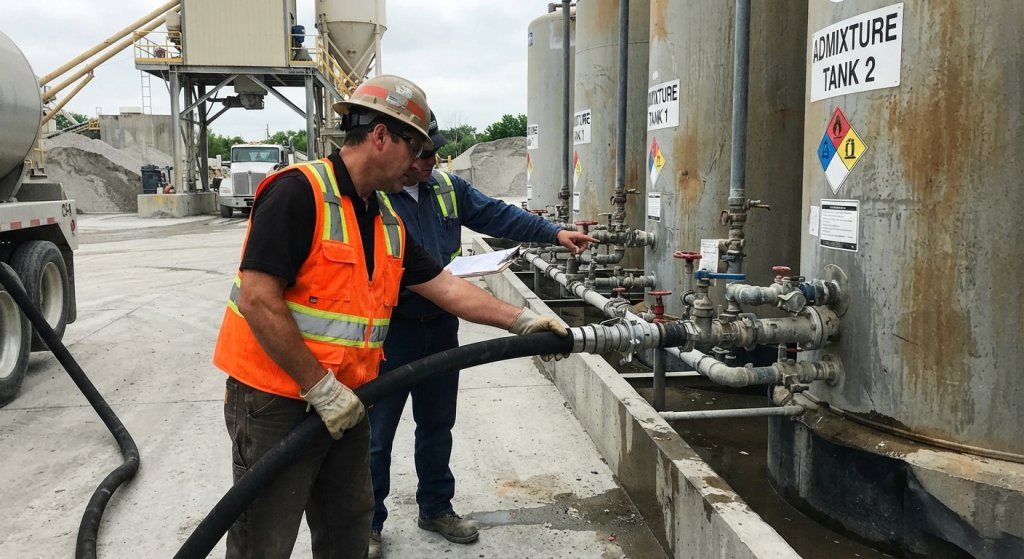
Stand at the delivery point and follow the intended flow path all the way to the receiving tank. Match the fill connection, line identification and tank label. Look for shared manifolds, changeover valves, portable hoses or unused branches that could lead to another container. Where a connection cannot be traced visually, the plant should use its documented line map and an authorized person who understands the arrangement. Never assume the routing because a fitting happens to be compatible.
This check is a simple form of error prevention. The National Ready Mixed Concrete Association’s quality-management guidance calls for monitoring admixture deliveries so they connect to the proper tanks. The article does not prescribe a particular color code or coupling design; a site-specific identification system is useful only if workers understand it, maintain it and verify it against the current plant layout.
3. Inspect the physical path before transfer
Review the hose, fittings and receiving point for obvious damage, loose connections, residue and signs of leakage before starting the transfer. The supplier and plant should agree which party owns the hose and who may connect or disconnect it. If the transfer uses a temporary line, its route should not obstruct vehicle movements or create a trip point for other workers. Protective arrangements must follow the product information and site procedures rather than a generic checklist.
Confirm that the tank has room for the expected delivery and that its level indication is credible. A reading that conflicts with the last inventory record deserves investigation before unloading. Also look at the tank’s access points and seals: rainwater, truck washdown water or another material should not enter unnoticed. Admixture tank connections are only one part of this path; the condition of the tank matters as much as the fitting at the vehicle.
4. Agree on who supervises the transfer
Name the person who will authorize the start, observe the transfer and confirm completion. The supplier driver may operate the delivery equipment while plant staff monitor the receiving tank; the exact division of work depends on their procedures. What matters is that the assignment is explicit. A receiving person should know how to stop the transfer if the destination looks wrong, a connection leaks or the level indication behaves unexpectedly.
Consider a hypothetical plant with two adjacent admixture tanks and one busy unloading bay. If the plant operator leaves to manage a truck queue while the supplier assumes the operator is still watching the tanks, both parties may believe the other is supervising. That example is hypothetical, not a Hengyuan customer incident. A brief handoff before opening a valve is more useful than discovering the ambiguity after the transfer has begun.
5. Protect the product from contamination and dilution
Liquid admixtures can be compromised by unintended water or by mixing with another product. Keep the receiving connection clean and protected between deliveries, and use the supplier’s instructions for any flushing or changeover. Do not return residue from a shared hose to a tank unless the approved procedure specifically allows it. The plant should also provide the drip-control measures identified in its receiving plan and handle any spill under its own environmental and safety process.
The NRMCA quality-management guidance explicitly highlights protection against rainwater and washdown-water contamination as well as supervision of the correct tank connection. ACI’s technical discussion cautions against intermixing multiple admixtures before introduction into concrete. These points support the basic receiving principle: product identity and cleanliness must be maintained from the delivery vehicle to the dispenser, not assumed because the final batch setting is correct.
6. Recheck the batching interface after refill
Once the tank has been refilled, the receiving handoff should reach the people who operate the dispenser. Confirm that the tank assigned in the batching system corresponds to the physical tank that received material. If the transfer required a valve change or line isolation, verify the intended normal configuration before production resumes. A refill is not complete from an operational standpoint if the material is in the tank but the batching team still relies on an outdated map or inventory entry.
Visual confirmation at the dispenser and appropriate accuracy checks are separate tasks from tank receiving. NRMCA notes that collecting material at the point of discharge into the mixer can check line integrity in addition to dispenser accuracy. ACI also discusses visual verification of admixture dispensing and the value of consistent timing in the batching cycle. For a broader discussion of dosing, see Hengyuan’s admixture dosing accuracy guide. This article focuses instead on the delivery-to-tank connection.
7. Close the handoff with a usable record
Record the delivery identifier, product, receiving tank, date and quantity according to the plant’s quality system. Include the names or roles of the people who checked the connection and supervised the transfer, plus any discrepancy that was resolved before unloading. If the delivery was stopped, do not turn a partial transfer into a normal completed entry. The record should let the next shift understand what actually happened.
Keep the process short enough to use during a busy delivery but specific enough to support traceability. A useful closing question is: could a batch operator arriving later identify which material is in the tank, which line was used and whether any abnormal condition remains open? If not, the handoff is unfinished. The same record can help the quality team distinguish a receiving issue from a later dispenser or mixture-design question.
Planning takeaway
Reliable admixture tank connections depend on three linked decisions: the right product, the right physical route and a clear transfer owner. The seven checks convert those decisions into a repeatable receiving conversation without claiming a universal equipment arrangement or a new industry rule. Hengyuan recommends adapting the sequence to the plant’s approved materials, supplier documentation and actual piping layout, then confirming the final tank-to-batching handoff before production continues.
Contact Us: +86 199 3949 4756